






研究团队:
Dou L, Zhang X, Cheng X, et al.
研究内容:
Abstract
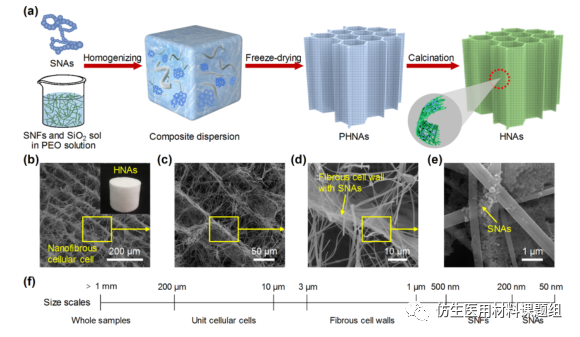
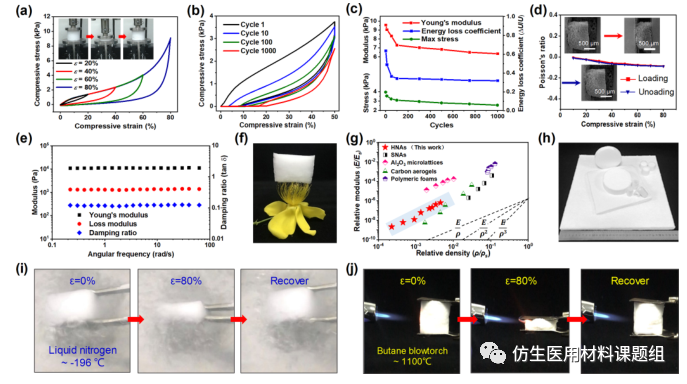
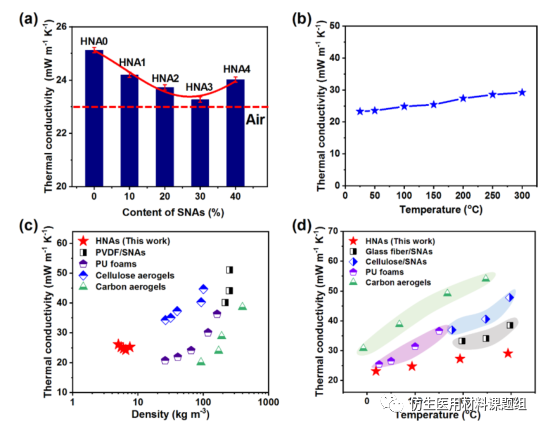
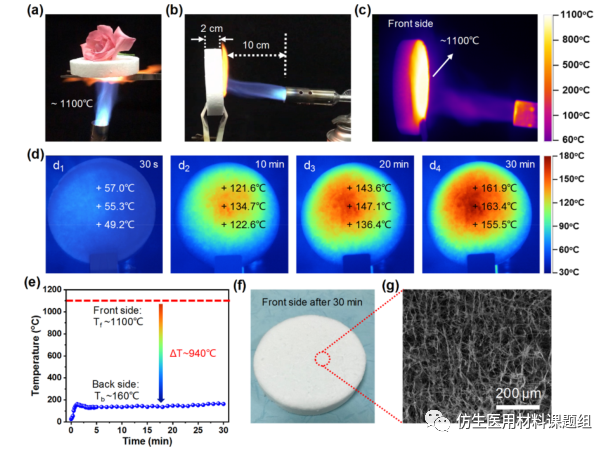
Silica aerogels are attractive for thermal insulation due to their low thermal conductivity and good heat resistance performance. However, the fabrication of silica aerogels with temperature-invariant superelasticity and ultralow thermal conductivity has remained extremely challenging. Herein, we designed and synthesized a hierarchical cellular structured silica nanofibrous aerogel by using electrospun SiO2 nanofibers (SNFs) and SiO2 nanoparticle aerogels (SNAs) as the matrix and SiO2 sol as the high-temperature nanoglue. This pathway leads to the intrinsically random deposited SNFs assembling into a fibrous cellular structure, and the SNAs are evenly distributed on the fibrous cell wall. The unique hierarchical cellular structure of the ceramic nanofibrous aerogels endows it with integrated performances of the ultralow density of ∼0.2 mg cm-3, negative Poisson's ratio, ultralow thermal conductivity (23.27 mW m-1 K-1), temperature-invariant superelasticity from -196 to 1100 °C, and editable shapes on a large scale. These favorable multifeatures present the aerogels ideal for thermal insulation in industrial, aerospace, and even extreme environmental conditions.
免责声明:素材来源于网络,仅供学术交流,侵删。由于小编水平有限,文献解读如有疏漏、错误之处还请各位读者批评指正。如需投稿,请联系我们